Showing posts with label toddlers. Show all posts

Thursday, April 12, 2018

Therapy Tip: Why Does My Toddler Have a Language Delay?

Hey there! It's Therapy Thursday on the blog. This is a day that I share knowledge based upon my experience as a pediatric speech-language pathologist and a mother of a child with special needs. Today's tip is:

Why Does My Toddler Have a Language Delay? 


I've been working in my state's birth-three program for over 10 years now. I have had numerous conversations with families. Often parents want general reassurance that their child's speech and language delay is not an indication of a life long problem. For some children, their delays are short term and go on to do well in school. (I know this because I have been able to follow up with some of these kids later.) Some parents will flat out ask me on my first appointment if their child has something wrong with them to explain their lack of verbal speech. Usually, autism is specifically asked about.

Many parents simply want to know why their toddler isn't talking. This is a hard question for me to answer. Sometimes, there are things in the history that can contribute to a delay in language development. I'm saying contribute to a delay because there are many factors at play in a child's life as you'll read below and it's just not always easy to absolutely find a "cause." 

There are some children who have no one single thing that I can pinpoint to as WHY they have a delay. They just do. There are some questions in life that can't be answered nice and neatly. However, there are some things can contribute to a speech and language delay requiring speech therapy.

Let's look at some.

1. Prematurity
Premature births can lead to some delays in language and other areas of development. Babies born prematurely can have delays in motor skills and language, especially if their prematurity resulted in a lengthy or complicated NICU stay. Usually, we will adjust a child's age to account for their prematurity until they are age 2. After age 2, we don't necessarily "blame" the prematurity as the reason, but it is one thing to consider. 

2. Hearing Issues
Known hearing loss will no doubt cause delays in language. Repeated ear infections can also contribute to delays in language because ear infections mean the child's hearing is not 100%. Not every child with ear infections will have a language delay, but it is one thing to follow up on and consider. If a child on my caseload has a history of ear infections, I strong recommend a hearing evaluation. If there is no history of ear infections, then I still tell parents a routine hearing screen is a good idea, but I leave it up to them to decide if/when to pursue it.

3. Environment
Some toddlers grow up in very language rich environments. Other children do not. Some babies and toddlers grow up with little interactions from their caregivers, too much time in front of screens, or too much time being contained alone in seats, swings, or playpens. Environments that offer little social interaction can contribute to a language delay.

4. Family Dynamics
Sometimes, the baby of the family talks and advances to keep up with their siblings. Other times, the baby of the family is treated like a baby. Helpful siblings will get things for the child who never has to utter a word. Family dynamics do not necessarily cause language delays but they can contribute to a child's lack of verbal speech.

5. Personality
There are some children I have on my caseload that are just quiet kids by nature. Their personality is passive or shy. This doesn't really cause a language delay, but it may be harder to get quiet-by-nature kids talking and making strides in therapy. They simply aren't as motivated to talk as some other children.

6. Delays in Other Areas
If a baby achieves motor milestones later than expected, then delayed language wouldn't be out of the ordinary. If the baby has significant feeding issues or delays in any other area of early development, then language delays may happen too. Child development is usually sequential, so we generally expect things to happen in a certain order. If some milestones happen later than expected, then that may mean language may come a bit later too. However, delays in multiple areas for more than a couple of months is something that would be worth looking into more closely to find a reason for the delays via a developmental pediatrician.

7. Underlying Diagnoses (Identified or Unidentified)
There are many underlying diagnoses that are associated with language delays. For example, Down syndrome or a brain injury are both known to have delays in language. There are some diagnoses that are not evident at birth but may become more pronounced by the time the child is 2 and not developing as expected. These are the toddlers I see with large delays in language and display other red flags that signal that something else may be the cause of the delay. Diagnoses like autism or childhood apraxia of speech, for example, may start to become visible in 2 or 3 year olds. So yes, a language delay may be because of another bigger diagnosis besides just "language delay" that may or may not have been diagnosed when the child starts speech therapy.


In all, there are many things that may contribute to a child's delay in language or explain the delay. It is often hard to exactly say "why" it is occurring and give the worried parent reassurance that their toddler will catch up and improve. Time will tell just how the child will progress. Even though we may want to understand why a child is experiencing a language delay, the important thing is to seek intervention and follow suggestions of the treating therapist.


Therapy Thursday is for educational purposes only and not intended as therapeutic advice.
submit to reddit

Thursday, April 5, 2018

Therapy Tip: When and Why to Use Withholding

It's therapy Thursday! By now, you should know the drill. This is the day that I share a tip based upon my work as a pediatric speech-language pathologist and my time at home with my child with special needs. Today's tip is:

When & Why to Use the Withholding Technique


What Is Withholding
Before we get into this post, let's first define withholding. The withholding technique is simply when an adult withholds an item that a child wants in order to encourage/force a child to say a word before receiving it.

This is probably the number 1 speech therapy technique that most parents report trying. If they are seeing me for an evaluation though, their use of withholding has not helped their child start talking.

Similarly, withholding is what I seem to hear non-speech therapist people recommend to mothers worried about their child not talking. They say something like this: If your child wants their cup, don't give it to them until they say "cup." These lay people may not know the actual technique name or exactly when and why to use it. That's when I have to explain why that may or may not work.

Sometimes, withholding is a good technique and sometimes it's not. It's just not an appropriate technique to use with every toddler who isn't talking. Plus, if this is ALL it took to develop speech, then why would so many children need speech therapy. Withholding isn't the answer for every child who is not talking.

When Is Withholding Helpful
I use withholding when I have a toddler in speech therapy who has a beginning vocabulary but isn't quite using words as their primary communication mode yet. Sometimes, the toddler is pointing, grunting, or gesturing instead of using their words despite having the ability. Other times, they are just quiet and not using their words consistently.

I do use withholding when I know that a child can say a word but they just aren't. So, if I have heard them say "more" or "please" multiple times, then I may decide to use withholding in order to get them to use that specific word. For instance, I will give the child one goldfish cracker. After he eats it, I will say, "If you want another one, say more." (Again, I have chosen a word that I know the child can say.) Then I wait. I may repeat my prompt, but I wait for the child to say 'more' before I give them another cracker. No word, no cracker.

Knowing what word to choose is important. If I have never heard a child say "cracker,' then I won't demand that they say that in order to get their crackers.

If you choose to do withholding, you have to follow through. You can't tell them to say a word and then give them the item whether they say it or not.

Why Is It Helpful
Withholding can be useful to help teach a toddler that words are powerful. Hopefully, we are showing them that pointing or grunting will not work anymore and that words are the prerequisite for getting the desired object. We want to teach the child to be consistent with their words in order to get their needs met. Getting consistent word use is important before adding more and more words into the child's vocabulary.

In all, withholding is a proper speech therapy technique that can be helpful when used properly, but you need to understand when and why to use it.

Therapy Thursday is for educational purposes only and not intended as therapeutic advice.
submit to reddit

Thursday, March 29, 2018

Therapy Tip: Easter Language Ideas

It's Therapy Thursday! Today is the day that I share a tip based upon my experiences as a pediatric speech-language pathologist and the mother of a child with special needs. Today's tip is:

Easter Language Ideas

This week, I am on spring break. I'm off work and spending some much needed time with my family. I have put 3 of my nice little Easter blogs on this post for you, so you can easily find them. These links have ideas for growing language and vocabulary related to Easter. So go ahead, take a look at these if you missed them the first time. 


10 Uses for Plastic Eggs

Building Language During Easter

Easter Sensory Bin


Therapy Thursday is for educational purposes only and not intended as therapeutic advice
submit to reddit

Thursday, March 22, 2018

Therapy Tip: 10 Uses for Plastic Eggs

It's Therapy Thursday! Yippee! Today is the day that I share a tip based upon my experiences as a pediatric speech-language pathologist and the mother of a child with special needs. Today's tip is:

10 Uses for Plastic Eggs in Speech Therapy


It's Easter! If there isn't already, there will soon be plastic eggs littered all over yards and homes. I love using these plastic eggs to change up activities for the work that I do with toddlers. Today, I thought I would give you 10 ways you can build speech-language skills with these plastic eggs. Obviously, anything small and plastic should be used with supervision for toddlers, but you knew that.

1. Color matching: Gather 10 eggs (2 of 5 different colors). Show the child how you can sort them out by placing green by green, blue by blue, etc. If it is too hard or too easy, change the number of eggs. You can also use an egg carton to make it a little more structured. On one row in the carton place 6 different colored eggs. Then, ask the child to place the matching color next to the egg in the carton. Still yet, you can get colored construction paper the same color as the eggs. Place the construction paper out and show the child how you can match the eggs to the same color as the paper.

2. Big/Little: You can reinforce the concepts of big and little in a couple of ways. First, you can simply get two different sized eggs to show big and little. Secondly, you can get small items and see which ones are little enough to fit inside the eggs and which ones are too big to fit in the eggs.

3. What's in the egg?: If you look hard enough, you can easily find things to place inside the egg. You can then teach vocabulary with the things that are in the egg. The child will have fun opening the eggs to see what is inside. It is important to pace the child, so that they only open one egg at a time and focus on the object inside. Some things I have placed inside the eggs have been: play money, little animal figures, a beaded necklace, plastic rings, pom-poms, small dinosaur, etc. Children have really enjoyed this activity with me in sessions. Again, anything small enough to fit in the eggs will require strict supervision, and this shouldn't be done with kids who frequently put things in their mouths.

4. Spatial Concepts: By placing eggs in different positions, you can teach many different spatial concepts. You can show the child the spatial concepts ("I'm putting this one in the basket." "I'm putting this one under the basket.") to teach them the concepts. You can "test" the child by telling them where to put the eggs by telling them to put it in/out/on/on top/under/next to/behind/in front of a basket, container, or chair.

5. Counting: This is sort of obvious. Count the eggs! If your child isn't counting very far, then count to 3 over and over with the eggs. If they can go higher, count higher. To make it harder, you can tell the child you hid 5 eggs. Count them out as they find them.

6. Following directions: Use the eggs to work on following 2 and 3 step directions. Examples of 2 step directions: Get the egg, and put it in the basket. Pick up an egg and bring it to me. Go to the couch and find the egg. Examples of 3 step directions: Go to the chair, get the egg, and put it in your basket. Find the egg, put it in your basket, and then come to me. Stand up, get the egg, and come back here.

7. Speech Sound Targeting: If your child is working on a specific sound like p or k, then you can put some things inside the egg that have the target sound for your practice. For instance, if you are doing initial /k/ words, you can put the following things inside the eggs: candy, key, cat, "K," kid, car, etc. If you can't find objects small enough to fit in the egg, then use stickers or find pictures of these objects from Clipart or magazines to stuff in the eggs.

8. Shakers: Fill those plastic eggs with items to turn them into shakers. You can use items that will create a soft noise and some that will create a loud noise so that you can compare items and teach those adjective words. Make sure you secure the egg shut with packing or duct tape so they won't spill out! To make a soft noisemaker, use pom-poms, rice, or gummy bears. For loud noisemakers, use rocks, beans, Legos, coins, and M&Ms. Add music to the activity and dance with these noisemakers as you remark on which ones are loud and soft.

9. Kitchen Fun: If you have pretend play kitchen items, add some plastic eggs to them. I love watching kids imitate me cracking the egg and pretending to cook them. This will work on pretend play, play imitation, and actions (crack, stir, cook, eat, cut).

10. High/low: Without the child present, you can hide eggs up high and down low. As they find the eggs, you can remark on the eggs that are low and up high. The ones that are up high will also create an opportunity for the child to ask for help since they will most likely need you to pick them up and help them get the egg.

Well, now you know what to do with all of those eggs sitting around. Have fun!

Therapy Thursday is for educational purposes only and not intended as therapeutic advice. 
submit to reddit

Thursday, March 15, 2018

Therapy Tip: Easter Sensory Bin

It's Therapy Thursday! This is the day that I share a tip based upon my experience as a pediatric speech-language pathologist and the mother of a child with special needs. Today's tip is:

Easter Sensory Bin


Sensory bins are fun and popular with young children. Sensory bins are simply containers filled with an item meant to provide some sort of texture to the child as they dig and feel around while playing. People often associate these with children with autism or sensory processing disorder, but these are useful and fun for all children. 

Working in homes of toddlers, I try to make up small sensory bins several times a year. Traveling from home to home to conduct therapy sessions, I use a small container to serve as my sensory bin. A small container is perfect for one child to play in and is easy for me transport. I generally don't fill the container completely full since some of the toddlers I work with will end up dumping out the contents.

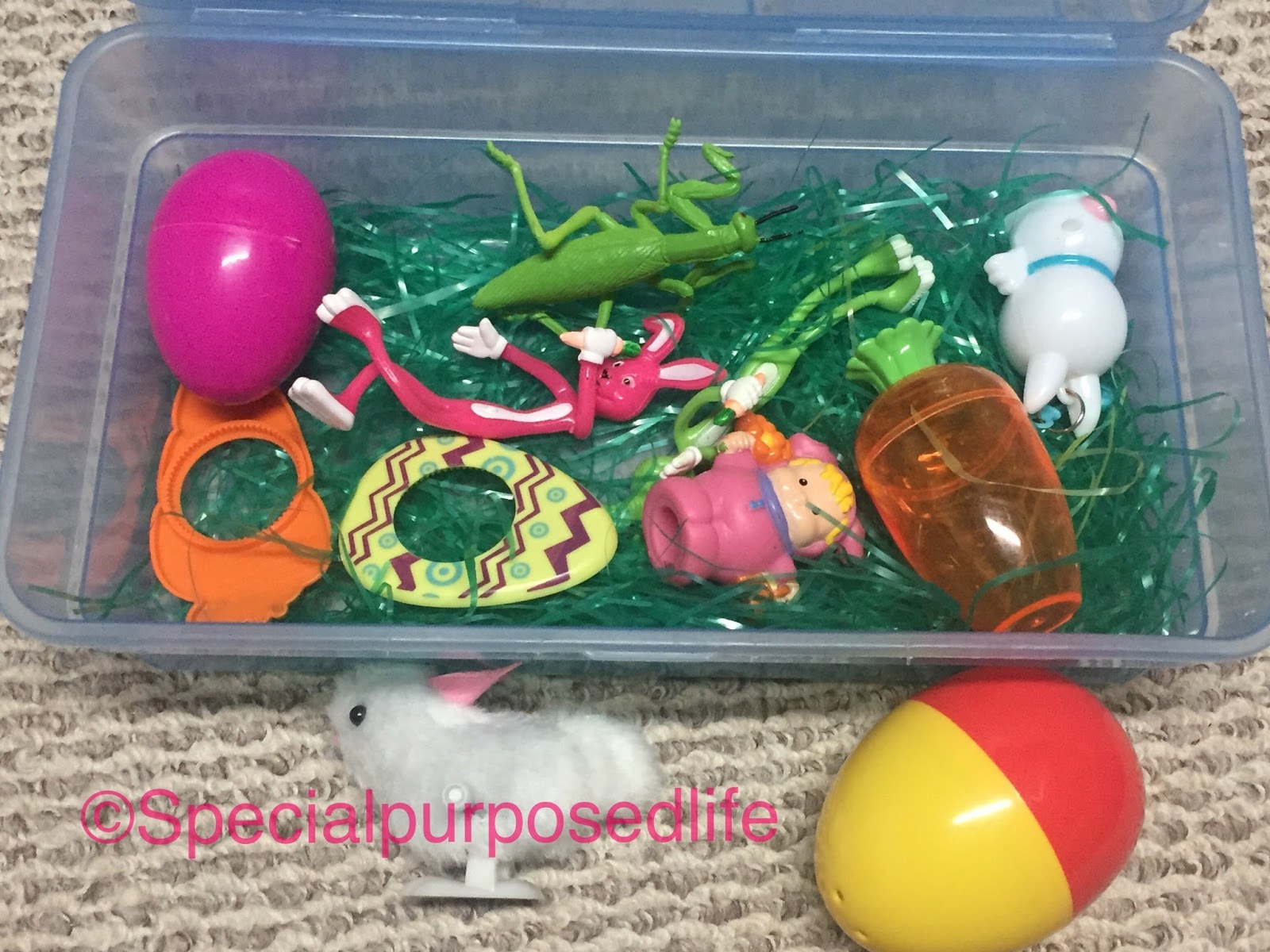
Generally, the base of the sensory bin contains something like uncooked macaroni noodles, rice, beans, shredded paper, pom-poms, etc. For my Easter sensory bin, I like to use the grass people often put in the bottom of Easter baskets. It has a texture that is a bit different. You could also use the green shredded paper that is found in stores, which you can also replicate easily. 

Next, additional items are placed in the bin based upon the fine motor skills that are being targeted or vocabulary that is being addressed. I collect little Easter related toys I find in dollar stores or on clearance at the end of the season to use in my bins. What you put in the bin can be different, but I'll share what I put in my mine for the work I do with toddlers and why.

For my Easter sensory bin, I use a couple of plastic eggs. One egg is big and one is small to target the size words. You can further reinforce big and little by seeing what will fit inside the eggs. The colors of the eggs can also be a target as well. Then I have a few rabbits in my bin to work on actions like hop, jump, or eat (which is why I have the carrots too). I like to bury the people under the grass for more actions like find and hide. I can line up all the rabbits and count them as they jump in the grass. You can model questions and phrases like, "Where's the bunny?" and "I see you." The vocabulary and phrases that you can target can continue from there. Of course, there are all sorts of targets, but these can hopefully give you an idea for your own bin.

Sensory bins are great for speech therapy because it allows me to use a fun activity to target several language skills. Have fun making one for your child! 

Therapy Thursday is for educational purposes only and not intended for therapeutic advice. 
submit to reddit

Thursday, March 8, 2018

Therapy Tip: How to Make Flashcards more Useful

It's therapy tip Thursday here at Special Purposed Life.

On Thursdays, I share an activity, idea, or advice based upon my experience as a pediatric speech-language pathologist and having a child with special needs. Today I'd like to discuss:

Flashcards: How can we make them more useful?  


I will be honest--I love flashcards for vocabulary building and articulation work. Many therapists despise them saying that pictures of objects are poor substitutes for the real thing. I do agree with that, but I do feel they can be useful. Using flashcards for a few minutes in a therapy session can be productive.

You can use flashcards in speech therapy to address several skills. First, flashcards are great for building expressing vocabulary by allowing children to work on naming pictures of objects. Next, by using 2 or more flashcards at once, you can ask the child to identify a picture to work on receptive language. Finally, targeting words in flashcards with specific sounds allows us to work on speech clarity (articulation), which is probably the most common use of flashcards in therapy. 

Let's back up though and talk about how I choose flashcards.

I prefer flashcards of pictures of real objects or real people, especially when teaching vocabulary. I occasionally use cartoon or drawn cards, but these are not my preference. Photographs are more accurate of the real thing than the drawn cards. These cards are fairly easy to find. I buy my cards at dollar stores, big box chain stores, and online at educational or therapy websites. These are some of my favorite sets:

Now that you have your flashcards, the next step is engaging the child.

If you are building vocabulary, then pairing a real object with the flashcard is a great activity that is usually fun for the child. I have thoroughly explained how to do this activity in the post First Words Activity. This takes flashcards to a different level, and I have found it helpful in therapy. But, you don't always have time or the materials available to make this happen.

So how do you make flashcards more entertaining when you are using them with toddlers or young children? 

There are some small children that will happily sit through naming and looking at each picture. Most children need some extra motivation to go through a short set of cards. I have found some pretty easy and motivating things to use with flashcards to make the kids more interested. 

Here's my favorite 3 things to use with flashcards.
1. A Basket: When the child says the word, they can drop the flashcard in the basket. Simple, I know, but this little trick works. It also teaches the child to focus on one picture at a time.

2. The Magic Box: This is a shoebox that I covered in wrapping paper. I made a small slit in the top of the box for a flashcard to slide through. Toddlers and preschool children tend to love this one. They say the word, then they get to put the card into the magic box. As you can tell, my box is well used. 

3. A Holder: This is a flashcard holder that I purchased through a therapy website. This holder is a little difficult for the toddlers I work with to do on their own. The cards slide right in the holder, and the pictures stand up. The flashcards in this holder are ones that I made myself using my digital camera and laminating machine.


If you have flashcards that you use in therapy or at home with your child, I hope this helps you understand how to make them more motivating and useful in therapy. 


This information is provided for educational purposes and not intended for therapeutic advice.

submit to reddit

Thursday, March 1, 2018

Therapy Tip: Mistakes to Avoid for Picky Toddlers

It's Therapy Thursday here on the blog. This is the day I share a tip based upon my experience as a mother of a child with special needs and a pediatric speech-language pathologist. Today's tip is:

Mistakes to Avoid for Picky Toddlers

For my job, I often evaluate toddlers with picky eating habits and determine if their eating is extreme enough to qualify for feeding therapy. Over the years, I have talked with many families about their child's food preferences and patterns. I have directly worked with many toddlers who have restrictive diets (eating from only 1 or 2 food groups or a total of less than 5 different foods), gag easily, or avoid certain textures.

Feeding therapy is interesting work. Every child is different and responds uniquely when work is started to expand their diets. The work done during therapy is important but what is done at home is vital as well.

In the years of working with families, I have come to see some common mistakes at home. These mistakes aren't the cause of the child's feeding issues, but we definitely need to correct these mistakes when we get serious about adding new foods to a child's diet.

Mistake #1: Offering the same foods to the child.
This is the number one biggest mistake that I see parents making. I understand how it happens. The child eats only a certain set of foods. In frustration and over time, the parent begins to serve those same foods to the child. Then the child begins expecting these same foods. It's a vicious cycle that happens before a parent realizes it.

It is really important to offer foods to the child that they don't normally eat. This can come formally by putting a new food on their plate or informally by simply offering the child a bite of food from the adult's plate. It can also be offering a new food for a snack before resorting back to the familiar food. Bottom line, even if we know the child won't eat a new food, it's important to keep offering it to remind the child that new foods are a normal part of daily life.

Mistake #2: Letting the child dictate what's on their plate. 
You may think this mistake is like the first, but it's slightly different. In addition to serving the same foods to the child, another mistake is to never put something new on the child's plate. I don't care if a child eats it or not, but I want the child to tolerate something new on their plate. Children who are extremely picky and need me to work with them will often get upset with merely the presence of a new food on their plate.

Before I expect them to eat a new food, first I want them to tolerate it on their plate without pressure to eat it. I want them to be ok with the fact that I have added ketchup next to their chicken nuggets or that I have put raisins next to their crackers. This does a couple of things. First, this will help expose them to new foods in a no pressure situation. If the child seems fine with it on their plate, then I encourage them to touch or smell or even pick it up and throw it away. Secondly, this promotes the child to interact with food in ways besides just eating. You never know too- the child might just decide to try something one day!

Mistake #3: Only having food interactions during mealtimes. 
If your child is a picky eater, it is important to have some interactions with food outside of meal time. These opportunities encourage the child to touch food or simply be around it without any pressure to eat.

Have the child help in the kitchen by preparing food for other people or assisting with snacks. They can help make a sandwich by putting the meat or cheese on the bread. They can put vegetables in a pot before it's heated. You can make a trail mix with the child and let them add cereal, raisins, or pretzels together. If you are familiar with sensory bins, then you can use foods as a base for them as a way for them to engage with food in play. For these bins, I have put cereal, dry noodles, dry beans, pretzels, etc. in a big Tupperware container with spoons, little figures, and other small toys to allow the child to dig in the food for a sensory play experience. (If you need more info on sensory bins, click here or click here for even more.) Generally speaking, eventually these interactions should lead to the child being more comfortable with food and possible deciding to taste something. Usually, the kids I work with in feeding therapy will be very anxious when we are doing these food interactions even though I am not asking them to eat anything, so this is a good activity for them.

The bottom line: Picky and problematic eating often needs some changes at home to promote new additions to the child's diet. Little things like the ones mentioned today should not be discounted. Picky eaters take lots of time to change habits, trial-and-error with foods, repeated exposures, and many changes to help expand diets. If you find yourself making these mistakes with your child, it's not too late to correct them! 

Therapy Thursday is for educational purposes only and not intended as therapeutic advice. 
submit to reddit

Thursday, February 15, 2018

Therapy Tip: 3 Great Toys for Toddler Language Development

It's therapy Thursday! It's the day I share a tip based upon my experience as a pediatric speech-language pathologist and the mother of a child with special needs. Today's tip is:

3 Toys I Love for Encouraging a Toddler's Language Development


If you search online or in stores, there are no shortages of toy options for children of any age. Any parent can get overwhelmed by the numerous toys that claim to work on different developmental skills. There are many good toys out there. Today, I'd like to share with you the 3 main toys I use to encourage language development and why.


1. Potato Head
Potato heads are great for many reasons. First, you can target the basic body parts like eyes, nose, and hands. Secondly, you can target the concepts in/out as your child places the parts in the potato head. Next, you can target the concept of 1 and 2 (2 ears, 2 hands, 2 eyes, 1 nose). Finally, you can hoard all the pieces from the child. Have them say a word or phrase to receive a piece to complete it. The multiple pieces gives you a chance to elicit your desired word or phrase multiple times. Beyond language, placing the parts in the body is a great fine motor experience.


2. Simple Puzzles
I love using 6-9 piece puzzles in therapy for language development as well. Puzzles are wonderful for some of the same reasons as the previous toy. First, the puzzle generally has a theme that hopefully has words to grow a vocabulary. Some pictures on puzzles are just not great for teaching vocabulary, so you have to think about this before purchasing a puzzle. There are many good puzzles featuring pictures of food, animals, vehicles, or familiar characters. If you hold all the pieces and give the child one at a time, you can really have them focus on the vocabulary of the pieces. Secondly, you can address following directions and vocabulary identification by holding 2 puzzle pieces in front of the child and tell them to get a certain piece. ("Get the cow.") Next, spatial concepts of in/out can be targeted. Finally, you can count the puzzle pieces to work on simple counting. Besides the language targets, puzzles are great for matching, cognitive skills, and fine motor.


3. Vehicles
Little cars, trucks, trains, and tractors are also wonderful toys for language. If your child is working on saying just 1 word at a time, you can use these toys to model simple words or sounds (whee, go, beep-beep, stop, mine, up, down). If your toddler is working on saying 2-3 word phrases, then the vehicles provide many opportunities to build phrases. Some examples of these include: go truck, stop car, green tractor, fast car, slow down, let's go. Next, you will notice that you can target many adjectives and actions using vehicles, which is really important if your child is working on phrases or sentences. Finally, you can use the vehicles to teach spatial concepts if you add in a table, box, container, or ramp. Using another object like this, you can show the child on top, under, in, on, and off.


As you can see, my top 3 toys for language development for toddlers are pretty common and easy to find. They are also relatively inexpensive, and you may already have them in your home. These toys can be maximized for language development IF you take time to engage WITH your child while they are playing with them. They do not have the same effect if the child is left on their own without an adult modeling words or sounds.


Therapy Thursday is for educational purposes only and not intended as therapeutic advice. 
submit to reddit

Thursday, February 8, 2018

Therapy Tip: Snow Day

It is Thursday, so you know it's time for therapy tip Thursday! This is the day that I share a tip based upon my experience as a speech-language pathologist and a mother of a child with special needs. Today's tip is:

Snow Day Language Fun

Have you had any snow days lately?

Nothing makes my son more joyful than seeing those snowflakes hit the ground. I love seeing the delight in his face. I remember when I was like him. Now as adult, I hate the interruptions snow brings. But, snow does bring a unique opportunity to work on language skills with your child under 5.

When my children were toddlers, I loved to go scoop some snow into a giant Tupperware container and bring it in the house. I didn't have to worry about my two year getting too cold out in the snow, and I didn't have to put layers and layers on that child. Whether you bring the snow inside or you brave the cold outside, here are some language skills you can target with your child under 5.

-Winter clothing: Mittens, gloves, boots, coat, and hat are all good vocabulary words that you can talk about while you are both bundling up.

-Adjectives: When playing with the snow, use adjectives to describe what the child is seeing and feeling. These include: cold, wet, freezing, and white.

-Action words: While playing with the snow, make sure you are saying the action word you are performing so the child can learn them (roll, scoop, pat, dig, throw, stomp, hide).

-Counting: Make several snowballs, and count them out for your child. To practice rote counting to 3, count to three before throwing a snowball. Ask the child how many snowballs they want, see if they give you a number word. Then use snowballs to show them how many that number is.

-Colors: If you are feeling very creative, you can use food coloring in spray bottles to tint the snow. Then you can talk about the colors you both added to the snow.

Always remember too, simply talking to your child during your snow play will work on language naturally. Asking questions, answering questions, giving information, and responding to your child are all natural things that shouldn't be discounted. Now, go enjoy your next snow day!


Therapy Thursday is for educational purposes only and not intended to be therapeutic advice.
submit to reddit

Thursday, February 1, 2018

Therapy Tip: Hearts, Love, and Language

Welcome to Therapy Thursday! This is the day that I give a tip based upon my experience as a mother of a child with special needs and a pediatric speech-language pathologist. Today's tip is:

Hearts, Love, & Language: Using Valentine's Day for Language Activities

Here in America, we will be celebrating Valentine's Day on February 14. As you have noticed in some of my previous therapy posts, I like to use seasons and holidays to change up some things that I do in therapy sessions. Valentine's Day is no different. Even though I work with toddlers, there are still elements of Valentine's Day that I can use in sessions to target language skills.

Here are some language skills you can easily work on with simple items found around the home:

-Big/Little:  Make hearts of different sizes using construction paper. You can then compare two hearts and decide which ones are big and which are little. I like to have two different containers to place the sorted hearts inside to make it more fun for the toddlers.

-Following directions: Using cut out hearts, stickers, crayons, etc., make a card with your child. Throughout the craft, give your child some simple directions to follow. "Pick up a pink heart. Open the glue. Flip the heart over. Choose a crayon." Making the card from beginning to end will work on task completion as well.

-Colors: Cut out 2 hearts for each color of construction paper you have. Shuffle the hearts up. Help your child sort through them to find matching colors. For an identification task, spread all the colored hearts out. Tell your child to pick out a certain colored heart such as, "Find pink." Finally, you can work on color naming by having your child tell you all the colors of the hearts.

-Shapes: Obviously, you can target the heart shape in these activities. You can add any other shape you want to compare two shapes (heart, circle). 

-Body parts: If your child is working on body parts, you can have them put a heart on the part as you name it. "Put the heart on your foot/belly/head."

-Spatial Concepts: Using cut out hearts along with poster board or construction paper, you can work on spatial concepts such as top, bottom, left, right, and middle. Hand the child a heart and tell them where to glue it using those words. If those concepts are too hard, try using a heart with an object like a small container instead of poster board. With this, you can work on the concepts top, under, in front, behind, next to, and inside. "Put the heart next to the box."

Have fun working on language tasks during this fun holiday!


Therapy Thursday is for educational purposes only and not intended as therapeutic advice.
submit to reddit

Thursday, January 25, 2018

Therapy Tip: The Easy Way To Grow Language

It is Thursday! That can mean one thing here on the blog. It is time for a tip based on my experiences as a mother of a child with special needs and a pediatric speech-language pathologist. Today, you will most likely have this material in your home to make this tip happen.

Books: The Easy Way to Grow Language


I cannot stress enough the importance of books for all children. This is especially true for young toddlers and children with language delays. If your child has a diagnosed language delay, daily book sharing is a great activity for you to do with your child. I know it seems simple, but book sharing achieves many language and development skills.

Here’s the thing, there are many toddler with delays that won’t sit for a book. I get it. I have had some of these kids in my therapy practice. They can be challenging but I try to attempt a book at least once in my session in order to build their tolerance to book. Why? Because I know how great they are. Here is what is happening during book time:

1. Vocabulary building: This is the obvious thing books target. When you read your child a story or simply look at pictures in a book, you are teaching them words. They are hearing the names of things. They may hear concept words like on or off or they may hear animal sounds. The words you are saying are helping them. If you get through one page, then yay! Maybe tomorrow it will be two pages. Start where they are at and talk and read to build vocabulary.

2. Attention span & listening: Your baby and toddler needs to be able to sit and attend to a short book. This is a skill I try to develop in therapy. If the child hates sitting still for a book and prefers to be up and moving with toys all the time, then they need to learn to sit briefly for a book. This is an important skill to develop in life in general but also to start building their attention span and listening skills. Kids who tend to like lots of input from movies or tablets may not appreciate the simplicity of a book, but we need to get them there. We need them to listen, focus, and attend to the pictures. Some kids I see in therapy will do books for more than five minutes. Other toddlers struggle to attend for thirty seconds. See where your child is and build from there.

3. Identification/pointing: Pointing is an early gesture that is so important. A child points to say look at that or I want that. Pointing then leads into identifying, which is an important language skill tested early on. We ask the child, “Where is the ball?” The child will hopefully respond by pointing to the right picture. Then we move to harder tasks like pointing to actions in pictures or specific colors in books. Identification tells us what a child understands. It also requires them to listen and look at the book with us as opposed to them quickly turning pages.

Almost every home I have done therapy in has had at least one book in it. Books are so important for children for a variety of reasons including the ones I listed today. Don't underestimate the usefulness and power of book time with your child with language delays. Now go grab a book, and get to it!

YOU MAY ALSO LIKE:
Therapy Tip: Selecting Books for Toddlers

Therapy Tip: Using Books to Build Language

Therapy Thursday is for educational purposes only and not intended as therapeutic advice.


submit to reddit

Thursday, January 18, 2018

Therapy Tip: 5 Ways to Break Screen Time

It's Therapy Thursday! This is the day that I share a tip based upon my experience as a mother of a child with special needs and a pediatric speech-language pathologist.

Last week, I shared how screen time needs to be avoided in toddlers, especially those with language delays. If you missed that post that shared the recommended screen time guidelines and why screen time isn't great, then CLICK HERE TO READ IT.

Today's tip is a follow-up post from last week:

5 Ways to Reduce Screen Time in Toddlers


You may realize that your toddler or young child may be getting too much screen time via the family's television, phone, or IPad. However, you may not have an idea of how to lessen the child's time on screens. Change doesn't take place overnight. It also doesn't happen by chance. Careful planning and adjustments need to be made to help reduce screen time, which we are hoping will increase the child's time playing with toys or engaging with other people.

Here's some tips to reduce screen time:

1. Don't automatically have screens on.
This is the biggest mistake I see parents make. The child gets up in the morning, and the tv goes on immediately (or the Ipad or phone) and stays on for the rest of the day. If your child is accustomed to having a screen on non-stop, make sure the devices are off at certain times. Having devices off in the morning, after naps, during meals, etc. sets a new routine for the child. By having times when these things are off (even if it's just for the duration of a meal at first), then you are getting your child use to times without the visual and auditory sensations that come from that device.

Screens in the vehicle are not necessary! Sure, if you are making a long trip, then you may need a screen to help your child cope with the long drive. If you are giving your child a screen for every small trip in the car, then something needs to change! There are plenty of other things you can offer your child to keep them happy in their car seat, but they may not want to accept these at first. Having music on the radio that would appeal to them can help. (I use to have the Wiggles on in my van, but it wasn't for me!) Often times both the child and the adult have gotten into these screen habits, but it's important to have times without them or activities that are screen free.

2. Keep devices out of sight and reach.
If your child truly loves their screens, then it's important to keep them out of sight and reach. Of course, you can't do this with televisions, but you can easily put phones, tablets, and dvd cases out of sight. If the child sees the tablet, they will want it. If you put it away, you can possibly delay giving it to them. Over the years, I have had to place my own child's movies out of reach in her closet or move the location of the tablet so that she wouldn't immediately go for these when she woke up.

3. Redirect and distract!
If the child indicates they want screen time, don't give in immediately. This is the second biggest mistake I see parents make. The child points to the television, and the parents put their show on. Try telling the child to wait a minute. Busy yourself with an activity if you must to show your child you can't do it immediately. Delaying the screen time will teach them that you are not giving in to demands when they want. This is an important first step!

Toddlers also respond great to redirection and distraction. Grab a toy that may give them extra sensory input such as a musical toy or play-doh or finger-painting. Do something physical with your child like throwing a ball in a box or jumping over small toys. Active play is a great distraction. Get down on the floor and play with your child! Engage them in play so they aren't left alone to think about their screens. This isn't feasible all day long, but this will be essential in the beginning if you are really trying to break a screen addiction for your child.

4. Let devices run down.
If the batteries run down in devices, don't charge them immediately. Let them be off. The child can suffer through the power outage, and it's one way to control the screen time. Just don't let them watch it while it's charging.

5. Just say no.
It's easy to suggest, but it's hard to do sometimes. It's ok to tell your child no. In fact, boundaries are great. Your toddler especially needs to understand and adapt to this word. Yes, you may have some tantrums and problems for a few days while they are adjusting, but you are the adult. You can tell them no. Playing with toys is not a punishment, but they may think it is in the beginning. You can use visuals such as a stop sign or a circle with a line through it to indicate to the child that screen time is over. You can also make a visual schedule with pictures showing the child the routine: breakfast, playtime, screen time.

If your child is spending hours watching screens, you need to make changes. At first, you may be decreasing their screen time for a few minutes over the course of a day, but you can keep building to increase their time off the screens. It will be hard at first, but in a few weeks you will thank yourself for what you did.


Therapy Thursday is for educational purposes only and not intended as therapeutic advice. 
submit to reddit

Thursday, January 11, 2018

Therapy Tip: #1 Thing to Avoid for Toddlers

It's Thursday! Time for another speech therapy tip. This is the day that I share a tip or piece of advice as a pediatric speech-language pathologist and the mother of a child with special needs. Today's tip is:

The 1 Thing You Should Avoid While Your Child is Learning Language

Today, I will get on my soapbox. I've been an in-home therapist for over 10 years now, and I have certainly seen a trend developing. Electronics have long been part of the adult world for some time now. But, I see babies and toddlers being introduced to smart phones and tablets more and more often.
There are guidelines set by the American Academy of Pediatrics (AAP). Basically, there should be no screen time for children 18 months and younger. No videos, movies, games, etc. on televisions, smart phones, tablets, or other devices. None unless you are video chatting with a person.

For those 18-24 months, children are allowed some screen time as long as it's educational in nature and the parents are nearby to remark on what the child is seeing.

For preschool aged children, an hour of screen time is allowed if it's educational and parents are nearby again to teach the child how to apply what they are watching and learning.
Click here to read more about these guidelines.

I know what you are thinking. These recommendations are strict and not practical. I get it. I'm not saying you need to follow these guidelines exactly. However, too much screen time early on should be considered bad, especially if the child has a language delay. I have been in too many homes for a speech therapy session where toddlers have easy and frequent access to their parent's phone, tablet, and/or television. Many parents see these devices as a positive thing that will help their child hear and learn language, but the opposite is true.

Children learn language from people and play. Period! Children learn best from a language rich environment that happens when a person talks and plays with them. Playing with your child with actual toys is the best way to help your child with and without language delays.

The benefits of play have well been documented in research. In play, a child works on developing fine and gross motor skills. They also work on imitation, problem solving skills, imagination, creativity, language, and cause-and-effect. Sure, apps and videos can do some of these same things, but trust me when I say this: Children need to learn language from people and through play!

Screen time is no substitute for your child engaging with another person. Screens provide entertainment that is rich visually and auditory, so they are easy for children to enjoy and love. But, they can also cause children to "check out" as they focus on the screen and ignore the world around them. 

If your baby or toddler has screen time for more than an hour a day, you need to reduce it! If your child obsesses over an app or a movie, then it's time to readjust routines to break that obsessions. If your child ignores their toys or doesn't use them appropriately (throws or holds them only), then they need more time playing with another adult showing them how to play (and how it can be fun!). This is all especially true if your child is showing some delays in language or has been enrolled in speech therapy.

Devices have their place, but their place should not be in front of your toddler all day long! Making changes is hard, but this change is critical to help your child's skills grow and flourish.


Therapy Thursday is for educational purposes only and not intended as therapeutic advice.
submit to reddit

Thursday, January 4, 2018

Therapy Tip: 1st Words Activity

It's Therapy Thursday! This is the day that I share a tip based upon my experience as a pediatric speech-language pathologist and the mother of a child with special needs. Today's tip is:

An Easy 1st Words Activity

If you read my blog, you'll know I have spent over 10 years working in my state's birth-3 program. I have spent hours and hours treating toddlers with language delays. Some children that start therapy with me have absolutely no words. Others may have just a word or two. For these children, I have a few different activities I like to do to encourage some basic first words. Today, I'm sharing one of my favorite activities.

I refer to this as my flashcard and real object match up.
Some therapists are very anti-flashcards. I don't mind them, but I don't necessarily use them every week either. They, like everything else, have their place.

Flashcards are a great bridge for toddlers who won't sit for short books. Books are essential for teaching vocabulary and expanding a child's attention span. Some children don't have any kind of attention for books, but they may sit briefly for flashcards. The flashcards allow the child to focus on the one word too, which is great for early language learners.

To make this activity, I looked through some of my many sets of flashcards that I purchased at local stores (Dollar Store, Walmart). Then I tried to think about real objects I had that I could pair with certain flashcards. 

As you see above in the picture, ball, shoe, and cup were 3 of the 10 cards I chose. These three were chosen because they are common words for toddlers. The rest of the words I chose were based off of what objects I could match up and what sort of words or sounds I could elicit from children. I used flower so I could target a sound effect (ah-choo). Bug is another word I chose because I could target words like yuck and ew in addition to the word bug. 

Whenever you have collected your flashcards and real objects, place them all in a bag to hold. Present your child with a flashcard. Draw their attention to the picture as you say the word. A few seconds later, present the real object while saying the word again. I will say the word while pointing to the real object and then the card. Then present the next flashcard and object taking cues from the child. Some toddlers need to move quickly through each pairing because their attention is short. Others will spend a good 30 seconds focusing on each word pair. The child will let you know how slow or fast to go. Some children may not be able to get through all 10 pairings you made, but hopefully over time, they will.  

If you are teaching sign language to your toddler, then model the sign as you present the pictures and the objects too. This is a great way to teach a few signs one at a time! 

This is a simple activity that is great for children just beginning to learn to speak, and you probably have most of the items you need to make it happen in your home. 


Therapy Thursday is for educational purposes only and not intended as therapeutic advice.
submit to reddit